From AI pilots to production in post-trade
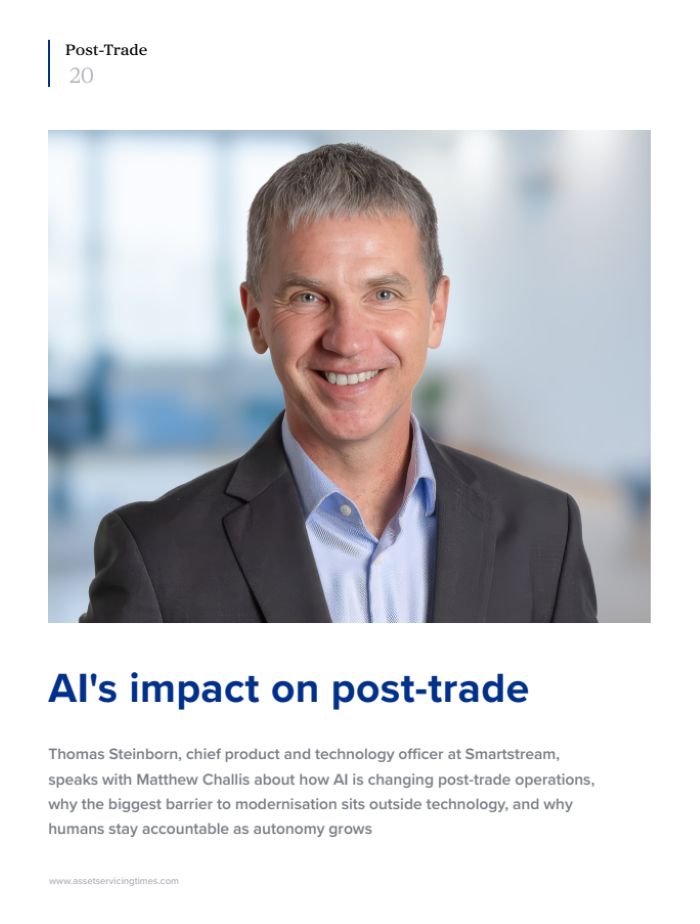
Thomas Steinborn, Chief Product and Technology Officer at Smartstream, sees the AI conversation in post-trade moving on from experiments to production and business cases. The focus is on where AI creates value: about 98% of transactions clear straight through, while the remaining 2 per cent, the breaks and mismatches, absorb roughly 70% of operational effort. Shortening the cycle time for resolving breaks and running investigations is therefore the priority for Smart Reconciliations for post-trade operations.
Roughly 15 per cent of Smartstream customers have taken their first agents to the point of moving them into production, in line with the wider industry. Tokenisation of assets is also gaining attention in Smart Collateral management for margin and risk, as banks look to lower margin costs and reduce risk.
Guardrails, autonomy and accountability
Hallucination risk is far less of a concern than a year ago. Smartstream combines advances in the models with decades of reconciliation knowledge as context, and pairs agents with its existing deterministic technology stack. The remaining bottleneck is observability: understanding how agents operate, which systems they call and what they can be accountable for.
The approach to autonomy works as a ladder. An agent first assists, then recommends, then acts with approval, and only then acts autonomously within defined bounds, as applied in Smart Agents for agentic exception handling. Thomas Steinborn, Chief Product and Technology Officer at Smartstream, adds: «And the question every bank should be able to answer is: what is your kill switch?»
Change management is the real modernisation barrier
With T+1 in place, some markets looking at T+0 and clients wanting near real-time processing, banks face constant pressure on round-the-clock operations. According to Thomas Steinborn, the biggest blocker to modernising legacy systems sits outside technology: change management and the cost of retraining operations teams that can reach 1,000 to 1,500 people.
The answer is continuous upgrade, where smaller, incremental changes spread the training cost, supported by a managed service that carries out upgrades for customers. Institutions can contact Smartstream about continuous upgrades and managed services.