Event risk defines operational risk in asset servicing
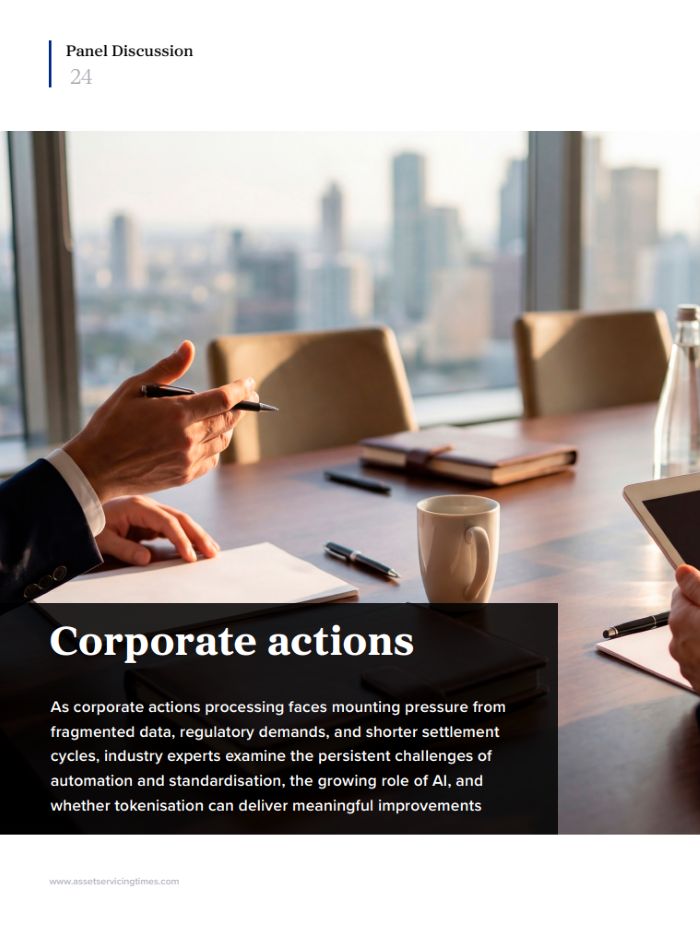
In a panel discussion on corporate actions published by Asset Servicing Times, Adam Cottingham, Global Head, Smart Actions at Smartstream, explains where processing still breaks down. His starting point: “Failure to define a corporate action at announcement will break in processing.”
“Event risk defines operational risk in asset servicing, measured across event type, market rules, position type and size, custodian network processing variances, and operational capacity. Measuring event risk is essential to mitigating operational risk and creating alignment.” Under T+1, “event processors have no slack to recover from data discrepancies, while legacy systems and manual processes remain the norm.”
No golden source, and two standards here to stay
On data quality, Adam Cottingham notes: “The mechanics of an industry ‘golden source’ have been understood for 20 years, but no authority or consensus exists to create one.” In its place, technology that supports alignment across counterparties, with granular reconciliation of positions, election outcomes and payments, makes a “documentation-verified truth source” available without a “golden source”.
On message standards, he adds: “A dual standard for asset servicing is here to stay.” Every translation between ISO 15022 and ISO 20022 can lose or reshape data, so dual-format events must be matched and reconciled. The same data object modelling that handles this variation also underpins Smart Actions corporate actions and proxy automation.
AI, SRD II and accountable automation
“AI regulation is converging on assistive, human-in-the-loop use with transparent, auditable decision making,” says Adam Cottingham. Generative applications integrated into client systems through the Model Context Protocol (MCP) are already in production, speeding alignment with the issuer and improving data quality. Next are agentic workflows for elections and communications, with a human approving each election. This fits the direction of Smart Agents agentic AI for financial operations.
On proxy voting, he points to the ongoing review of the Shareholder Rights Directive: “Effective governance of the proxy chain will need to become more transparent and technology-driven.”
Tokenisation and corporate actions in 2030
“Tokenisation speeds the passing of events and reduces reconciliation and payment lag, but it requires data consistency or it accelerates breaks,” says Adam Cottingham. “But DLT does not fix the data at its source. If the issuer’s terms are ambiguous or published late, the ledger simply carries the same error faster.”
His outlook for 2030: “By 2030, asset servicing operations will be centred on event risk, able to tokenise mandatory events, running an eventual data consistency model for voluntary events, and still discussing how to comply with SRD III.”