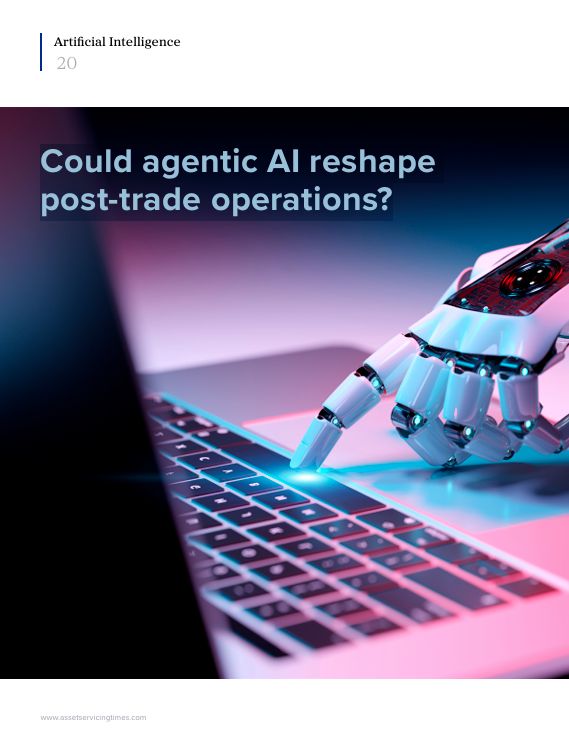
When speed is not enough – the case for agentic AI in post-trade operations
The shift to T+1 settlement has not increased the volume of reconciliation work – it has compressed the time available to complete it. For financial institutions managing large exception queues, the traditional model of waiting for analysts to step in, investigate, and resolve breaks is no longer sufficient. The window is shorter, but the standard of accuracy remains unchanged.
Robin Hasson, head of reconciliation solutions at Smartstream, sets out the challenge plainly: firms must achieve the same level of data quality, completeness, and accuracy – within a tighter timeframe and without the option of scaling headcount to absorb the pressure.
Always-on investigation – shifting from reactive to preventative
One of the most significant changes that Smart Agents introduces to post-trade operations is the move from reactive exception management to preventative analysis. Rather than identifying a problem only after a failure has occurred, agentic workflows analyse data upfront – investigating and correcting issues before they result in a break. This earlier intervention reduces settlement risk and removes the cost of downstream remediation.
Unlike human analysts, AI agents operate continuously and are not constrained by working hours or shift patterns. Investigation queues do not build up overnight or across weekends. Agents begin analysing breaks, gathering information, and forming recommendations as soon as exceptions arise – with human review integrated at governance checkpoints rather than at the start of every task.
Governance and human oversight remain non-negotiable
Hasson is clear that the current phase of agentic AI deployment is not one of full autonomy. Firms are maintaining a human-in-the-loop approach, particularly in regulated environments, where controls over decision-making, auditability, and data lineage are central requirements. The role of the operations analyst evolves – from manual investigator to supervisor of AI-generated recommendations – but responsibility for the final decision remains with the user.
The risks of unchecked automation are acknowledged directly. AI hallucinations, unintended consequences in production systems, and governance failures in regulated environments are real considerations. For Hasson, auditability cannot be an afterthought: every action taken by an agent must be logged, traceable, and accountable. Smartstream’s Smart Agents platform is built with this principle embedded – providing full explainability and maker-checker workflows alongside its autonomous capabilities.
Elastic capacity – scaling operations without scaling headcount
Agentic infrastructure also introduces a new model for operational capacity planning. Rather than hiring additional staff ahead of peak periods – month-end spikes, market stress events, or settlement backlogs – firms can scale computing resources and agent capacity on demand, then contract again when volumes normalise. Hasson describes this as an elastic workforce: one that does not require onboarding, training, or fixed operational overhead.
The longer-term implication is a fundamental shift in how back-office operating models are structured. Agentic AI is not simply a tool for managing T+1 pressure – it is a mechanism for rethinking the economics and architecture of financial operations more broadly.
Read the full interview in Asset Servicing Times
This article is drawn from an interview with Robin Hasson published in Asset Servicing Times Issue 390. To learn more about how Smartstream is applying agentic AI to reconciliation and exception management, visit the Smart Agents solution page.