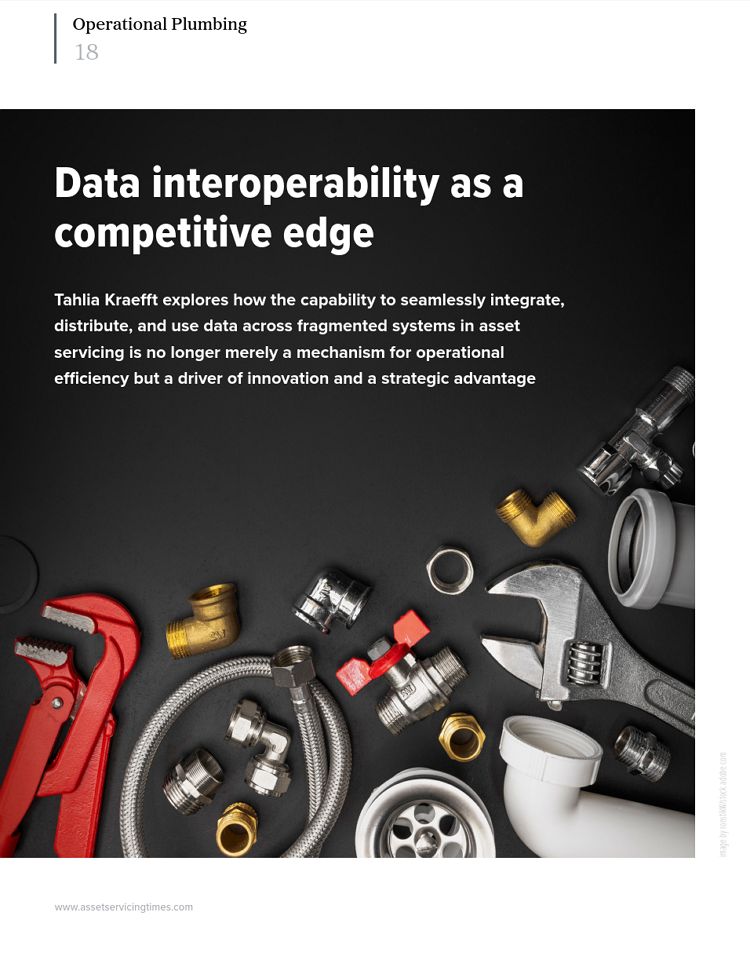
Data interoperability has evolved from a back office operational plumbing role to a competitive differentiator for asset servicers, allowing firms to steer quicker decision-making, lower costs, and improve client experiences. As asset servicing volumes increase steeply, with a 25 per cent year-over-year (YoY) rise and 67 per cent of errors are the result of data problems, the capacity to harmoniously connect diverse, legacy, and new digital systems through APIs and cloud is not purely important for business agility but key to a firm’s existence and strategic advantage. It comes against a backdrop of providers moving from siloed, legacy systems to API-driven modular architectures enabling operational alpha and real-time client services.
From operational plumbing to strategic edge
Data interoperability has crucially changed from an IT department requirement to a distinguishing commercial edge, led by the increase of complex multi-provider ecosystems, the requirement for real-time data insights, and strict regulatory demands. Asset servicing faces strong pressure from margin compression, the swift rise of alternative assets, and the need to provide personalised client experiences. Consequently, switching costs, onboarding speed, and data usability have shifted from operational concerns into front-line considerations that affect alpha, cost, and client experience.
Robin Hasson, head of reconciliations solutions, Smartstream
Robin Hasson, head of reconciliations solutions, Smartstream, describes interoperability as not just an operational upgrade but a strategic game-changer: “[It is] no longer a technical checkbox; it’s the foundation for growth. By moving from managing data to trusting it, asset servicers can accelerate innovation, reduce operational drag, and deliver richer insights to clients. In a market where speed and certainty matter, interoperability isn’t just a differentiator — it’s a catalyst for sustainable success.
“Interoperability shifts the value proposition for asset servicers. Success no longer comes from simply holding data in custody, it comes from how effectively you move that data and integrate it into a client’s broader ecosystem. This change requires a pivot in investment, product design, and governance.”
Madhu Ramu, head of product for software and lending solutions, at S&P Global Market Intelligence, says the providers that approach data as a high-performance product, and prioritise transparency and ease of access will be the winners: “Investment priorities are moving away from maintaining closed systems and toward building open, scalable back-ends. True interoperability requires more than just a modern interface.
“It requires an underlying architecture that can handle massive volumes without a proportional increase in headcount. For a service provider, the goal is to improve unit economics by automating the lifecycle of a trade or a corporate action so that data flows without friction. Success is now measured by the ability to scale volume without scaling costs.”
Clément Miglietti, chief product officer and chief technology, NeoXam, describes interoperability as a competitive capability that separates leaders and laggards: “Investments in modern data platforms, open interfaces, and governed data processes are prioritised over incremental system patches. Data governance is no longer a back office compliance function; it is the commercial foundation for trust in every number an asset servicer delivers.
“The ability to demonstrate quality, lineage, and control underpins trust with clients and regulators alike. Servicers that embed these capabilities into their technology and operational model are better positioned to adapt to evolving asset classes, regulatory change, and the integration demands of large institutional clients.”