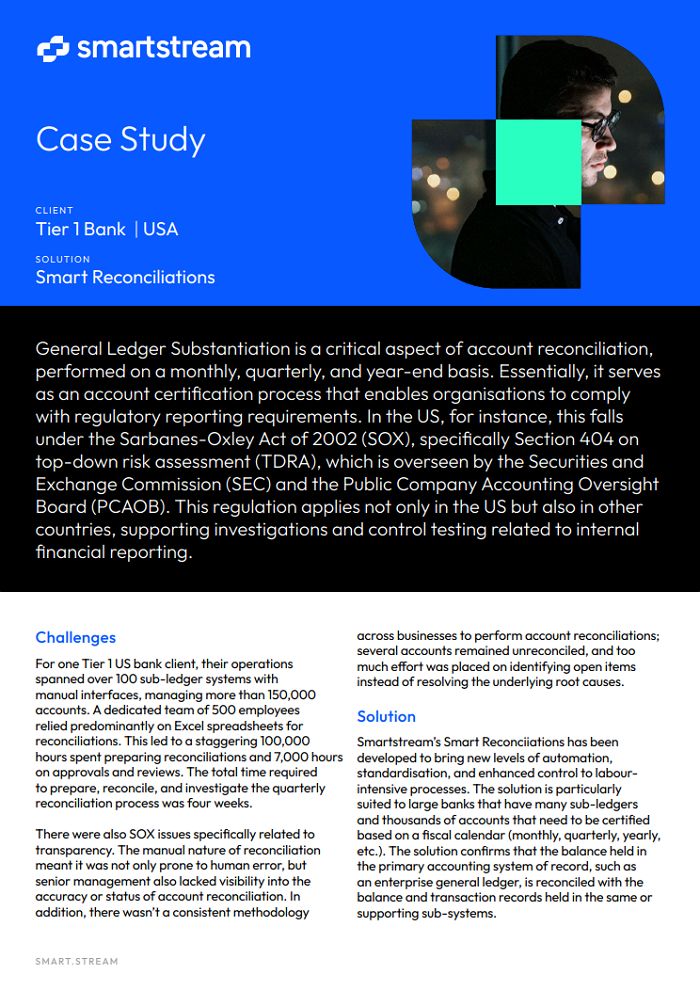
General Ledger Substantiation is a critical aspect of account reconciliation, performed on a monthly, quarterly, and year-end basis. Essentially, it serves as an account certification process that enables organisations to comply with regulatory reporting requirements. In the US, for instance, this falls under the Sarbanes-Oxley Act of 2002 (SOX), specifically Section 404 on top-down risk assessment (TDRA), which is overseen by the Securities and Exchange Commission (SEC) and the Public Company Accounting Oversight Board (PCAOB). This regulation applies not only in the US but also in other countries, supporting investigations and control testing related to internal financial reporting.
Challenges
For one Tier 1 US bank client, their operations spanned over 100 sub-ledger systems with manual interfaces, managing more than 150,000 accounts. A dedicated team of 500 employees relied predominantly on Excel spreadsheets for reconciliations. This led to a staggering 100,000 hours spent preparing reconciliations and 7,000 hours on approvals and reviews. The total time required to prepare, reconcile, and investigate the quarterly reconciliation process was four weeks.
There were also SOX issues specifically related to transparency. The manual nature of reconciliation meant it was not only prone to human error, but senior management also lacked visibility into the accuracy or status of account reconciliation. In addition, there wasn’t a consistent methodology across businesses to perform account reconciliations; several accounts remained unreconciled, and too much effort was placed on identifying open items instead of resolving the underlying root causes.
Solution
Smartstream’s Smart Reconciliations has been developed to bring new levels of automation, standardisation, and enhanced control to labour-intensive processes. The solution is particularly suited to large banks that have many sub-ledgers and thousands of accounts that need to be certified based on a fiscal calendar (monthly, quarterly, yearly, etc.). The solution confirms that the balance held in the primary accounting system of record, such as an enterprise general ledger, is reconciled with the balance and transaction records held in the same or supporting sub-systems.
Benefits
A key attraction for the bank was the opportunity to leverage the solution to create an efficient account reconciliation method, which produced timely reporting to management throughout the cycle. Other reasons included digitising the reconciliation process, significantly shortening the cycle time, tightening control, and increasing the productivity of reconcilers, allowing more time for exception resolution and the elimination of defects.
The main advantages of Smartstream’s Smart Reconciiations solution is its automation and control capabilities, driving productivity improvements, process consistency and visibility, and the shortened cycle time that CFOs and controllers seek for their financial close. The monthly process had historically been tracked through the creation of hundreds, if not thousands, of spreadsheets, each stored and maintained independently, giving poor oversight of the progress being made across the reconciliations. By contrast, General Ledger Substantiation provides a single repository for all components of the reconciliation process, from account details to balances and any substantiating documents. It has a standard state model, which offers complete visibility for all users, ensuring they know at what stage each reconciliation is through a single real-time dashboard.
The outcome is a robust risk management framework, strengthened through automated, real-time reconciliations applied daily, monthly, and quarterly at both the account balance and transaction levels. The solution’s tracking capabilities also ensure that fewer accounts remain unreconciled; with the single repository, all aged items can be monitored and resolved in a timely fashion. Additionally, the typical spike in activity around month-end is flattened, ensuring an even workload.
Moreover, costs are lowered and timetables reduced as operations are less labour-intensive, meaning a lower headcount is required for the operation due to workflow-based processes for account ownership assignment, distribution of reconciliation results, and exception management.
The client has found tangible benefits. Preparation time was dramatically cut, with one business unit showing a saving of 89%, with the number of man-hours reducing from 890 to 97. In addition, the overall effort for the reconciliation cycles also fell by 5%, allowing more time to be spent completing higher-quality reconciliations. Smartstream’s experience and expertise support the organisation’s move to more controlled, efficient, and transparent general ledger substantiation processing.