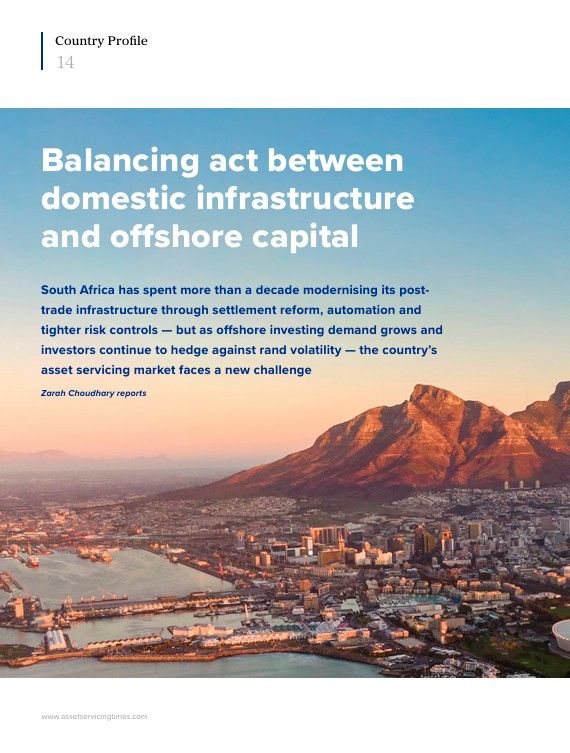
Africa’s most sophisticated post-trade market faces a new balancing act
South Africa has long been regarded as the largest and most operationally mature asset servicing market on the African continent – a status built over decades through sustained investment in custody infrastructure, settlement reform, and regulatory controls centred around the Johannesburg Stock Exchange (JSE) and central securities depository Strate. That foundation has made South Africa a gateway for regional and international investment flows into Africa.
But the market is now navigating a more complex set of pressures. Growing demand for offshore investment, rand volatility, intensifying regional competition, and the legacy of a Financial Action Task Force grey-listing period between 2023 and 2025 are reshaping the priorities of custodians, asset managers, and infrastructure providers operating in the country.
Settlement reform and the operationalisation of post-trade
The JSE’s transition from a T+5 to T+3 settlement cycle, introduced in 2013, was one of the most consequential infrastructure changes in South Africa’s post-trade history. The programme required widespread changes across brokers, custodians, buy-side firms, central securities depository participants, and settlement participants – introducing the Equities Clearing System, automated settlement instruction processing, and real-time deal management capabilities.
The reform was not an isolated event. It reflected a broader shift toward operational sophistication that has continued to develop in the years since, with South Africa placing increasing emphasis on settlement discipline, operational resilience, and clean reconciliation. The country’s corporate actions infrastructure is a notable example: entitlements are credited on the contractual pay date, with the market prioritising completion and timeliness over extended post-pay-date exception handling.
Offshore demand and the limits of domestic diversification
South African investors have become increasingly global in their allocation behaviour. With approximately 350 equities listed on the JSE’s main board compared with around 60,000 globally, and roughly 1,300 locally registered funds versus more than 200,000 internationally, the domestic market cannot provide the breadth of exposure institutional and retail investors increasingly require. Demand for foreign currency exposure and protection against rand volatility has reinforced this trend.
The result is a growing volume of cross-border investment structures – feeder funds, offshore custody arrangements, foreign currency settlement, and asset swap mechanisms – that are reshaping the operational requirements of South African custodians and platform providers. Mauritius continues to function as the principal offshore gateway connecting African markets to global capital, and remains relevant across parts of the fiduciary and fund services value chain.
Resilience and control are now the dominant drivers
Even as capital flows offshore, the operational conversation inside South Africa is increasingly focused on domestic control. Maintaining parallel servicing structures across multiple jurisdictions adds complexity, oversight obligations, and cost. Firms are reassessing how much of their operational infrastructure should sit externally – not only for cost reasons, but because operational resilience, data governance, and regulatory oversight have become central to what institutional clients expect.
Traditional models relying on siloed data and fragmented systems are under pressure to deliver the transparency and agility that clients now demand. Global custodians are responding by combining international scale with stronger local operational capability – investing in regulatory responsiveness, client proximity, and technology infrastructure including readiness for digital assets and real-time processing environments. The Smart Reconciliations platform supports this shift, enabling financial institutions to maintain clean, auditable reconciliation across domestic and cross-border operational structures.
A hybrid model – and the complexity it brings
South Africa’s asset servicing market is moving toward a hybrid model rather than a purely domestic or offshore approach. Domestic infrastructure continues to strengthen through automation, settlement controls, and operational reform. At the same time, the case for offshore exposure – for diversification, currency hedging, and global fund access – remains too strong to reverse. The two tracks are evolving in parallel rather than converging.
That hybrid structure will bring greater operational complexity for asset servicers. Meeting rising investor expectations around speed, transparency, and resilience – while managing cross-jurisdictional data governance, regulatory compliance, and settlement obligations – will require both infrastructure maturity and operational agility. For firms managing securities and custody operations across this environment, solutions such as Smart Reconciliations provide the exception management and settlement control needed to operate reliably across both onshore and offshore structures.