Why Reconciliation Is Moving from Back Office Task to Strategic Control Layer
Buy side operations teams are operating under unprecedented pressure. Compressed settlement cycles, rising market complexity, growing data volumes, and increasing dependency on third‑party providers are converging to expose long-standing weaknesses in reconciliation and data control.
To understand how buy side firms are responding, Smartstream recently convened a roundtable of operations leaders across the investment management community — the findings are captured in our Smart Reconciliations: The Buy-Side Perspective report. The results point to a clear conclusion: while awareness of risk is high, operating models are struggling to keep pace.
Reconciliation, once viewed as a necessary post trade function, is fast becoming a strategic determinant of operational confidence, resilience, and control.
A landscape still dominated by batch processes
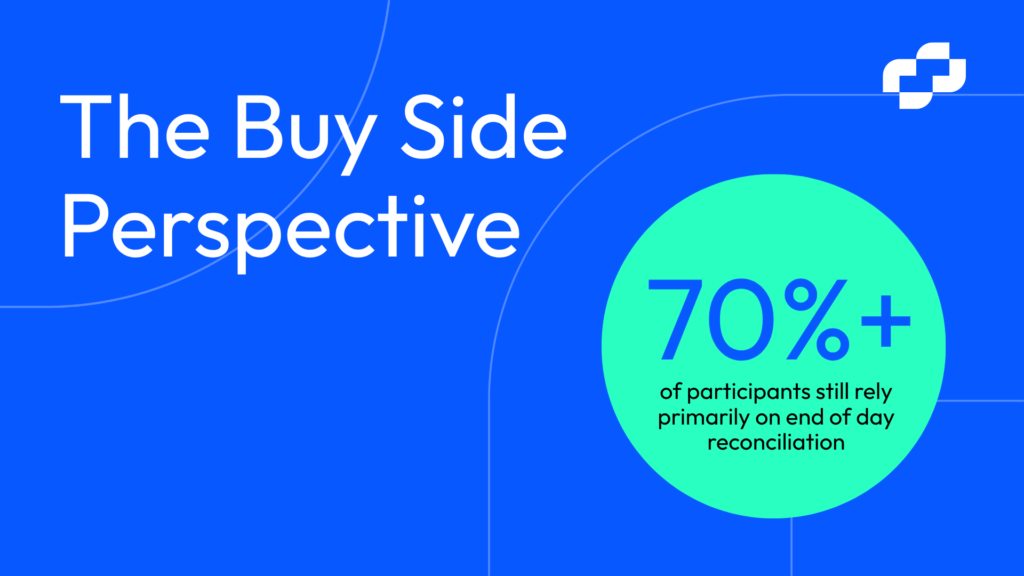
Despite years of investment and automation, more than 70% of buyside firms still rely primarily on end‑of‑day reconciliation. In parallel, over half of participants report increasing timing differences and data mismatches, a clear sign that exceptions are growing faster than controls.
71% primarily use end-of-day batch reconciliation. Only 18% operate near real-time or intraday controls.
Batch reconciliation was fit for purpose when settlement cycles were more forgiving, and transaction complexity was lower. Today, it creates blind spots. Issues surface too late, remediation windows shrink, and operational risk concentrates in the final hours of the day.
What institutions are experiencing is not a failure of effort, but a mismatch between legacy models and modern market reality.
Data integrity risk has moved beyond internal systems
One of the most striking findings from the roundtable is where firms now see their greatest data integrity risk.
Most respondents pointed not to internal systems, but to external data dependencies custodians, brokers, fund administrators, and other third parties. Incomplete data, inconsistent formats, and delayed delivery are steadily eroding confidence across reconciliation, valuation, and reporting.
59% cite external data dependencies as their primary integrity risk. 47% highlight front-to-back internal data inconsistencies.
In this environment, reconciliation is no longer about aligning internal books. It is about maintaining control across an extended ecosystem, where accountability can easily become blurred.
Leading firms are responding by shifting reconciliation earlier in the data lifecycle, focusing on normalisation and enrichment at source rather than downstream exception repair.
T+1 has changed the stakes
T+1 settlement has acted as a catalyst, turning longstanding challenges into immediate pressures.
41% of participants now view data quality as a critical priority, yet nearly 70% describe their operating model as still evolving. Funding and liquidity management were identified as the most impacted areas, highlighting how reconciliation delays can now translate directly into financial risk.
T+1 has exposed a simple truth: reconciliation can no longer be episodic. It must operate as a continuous, intraday control process, capable of supporting real-time decision making rather than retrospective validation.
Oversight gaps are widening as complexity grows
As buyside firms lean more heavily on third-party providers, effective oversight becomes harder, but also more important.
Yet almost half of roundtable participants report no material change in how they oversee custodians and administrators, despite rising dependency and tighter timelines. Data consistency, transparency, and timeliness remain persistent concerns.
More mature operating models are evolving towards independent validation maintaining clear ownership of data integrity and exception governance, without duplicating effort or inflating cost.
Efficiency lies upstream, not in more automation
Automation remains the top efficiency priority for buyside firms, but the roundtable revealed a critical nuance: automation alone is not enough.
Many organisations are attempting to automate on top of fragmented data, inconsistent enrichment, and legacy workflows limiting the impact of technology investments.
Sustainable efficiency comes from a different starting point:
- Consolidating data across internal and external sources
- Normalising and enriching before matching
- Governing exceptions systematically, rather than multiplying them
This shift reframes reconciliation as a strategic control layer, one that supports faster decisions, stronger oversight, and operational resilience.
From reconciliation as cost to reconciliation as confidence
The buyside industry is clearly in transition. Firms understand the risks, feel the pressure, and recognise that traditional approaches are no longer sufficient.
Reconciliation is no longer just about matching records at the end of the day. It is about trust in data, timeliness of insight, and defensibility under scrutiny especially in a T+1 world.
Those that modernise reconciliation most effectively will do more than reduce cost and manual effort. They will gain confidence: confidence in their data, their controls, and their ability to operate at scale as market demands intensify.
Want to explore this in more detail?
Download the full Smart Reconciliations: The Buy-Side Perspective report to discover how leading buy-side firms are re-engineering reconciliation to build continuous, intelligence-led control — and why reconciliation is fast becoming a cornerstone of operational confidence.
Ready to see it in action? Register your interest for a tailored demo.