Payment investigations: still one of the highest-cost operational challenges
Despite significant investment in payment infrastructure, investigations remain one of the most expensive and time-consuming challenges across modern payment operations. Multiple payment rails and correspondent chains, limited end-to-end visibility, manual interpretation of messages, and a high and rising cost-to-serve – each exception triggers delays, rework, and operational risk that accumulates at scale.
For operations teams managing cross-border and multi-rail environments, the absence of a unified investigation framework means that every exception demands disproportionate time and effort – regardless of its complexity.
A guided, predictable investigation process
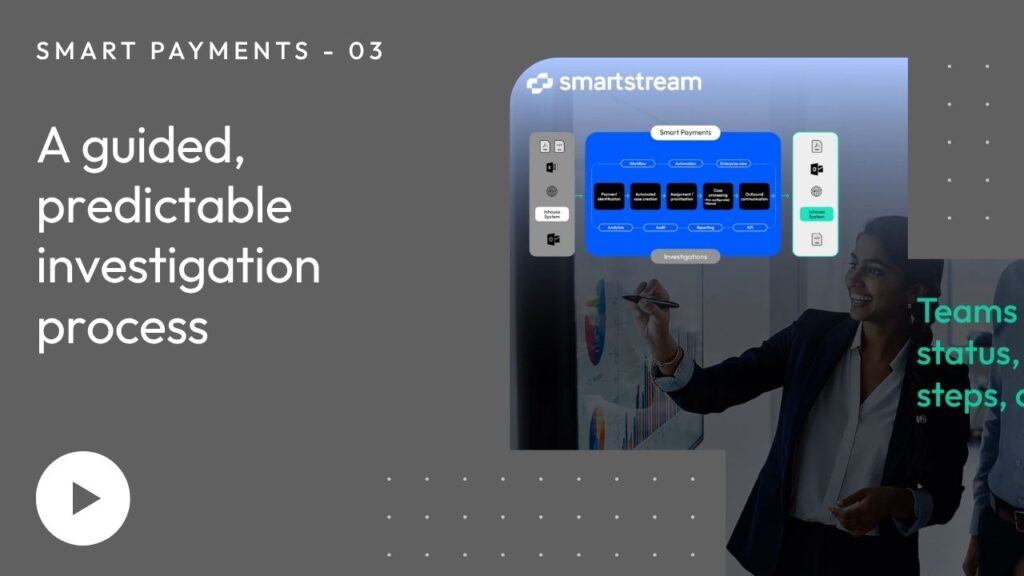
Smart Payments changes the way investigations are managed. By combining real-time visibility, guided task-driven workflows, and automation, it turns what was a fragmented, reactive process into a clear and predictable one. Requests are routed to the right party first time. Pre-checks resolve issues before they escalate. Automated acknowledgements and reminders keep cases moving. And every action is fully auditable.
Teams gain a single view of status, ownership, and next steps across all payment rails – SWIFT, RTGS, instant, domestic, and cross-border – removing the need to navigate multiple systems or manually track case progress.
Measurable impact on cost, effort, and resilience
The operational impact of Smart Payments is measurable. For non-complex cases, institutions have achieved up to 75-80% faster investigation resolution, alongside reductions in manual effort, liquidity costs, and compensation exposure. Beyond fixing breaks after they occur, Smart Payments helps institutions prevent issues at source – creating leaner, more resilient payment operations with higher confidence for both operations teams and their clients.
To see how Smart Payments can transform your investigations workflow, visit the solution page or connect with Smartstream at smart.stream/connect.