Governance is the common requirement for bank AI
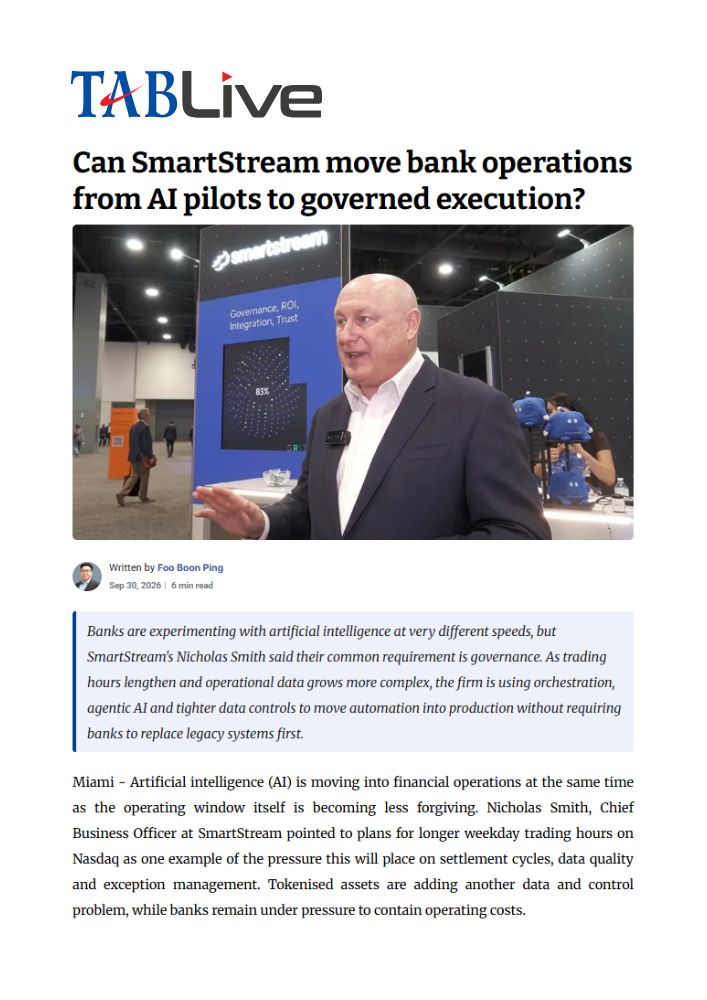
Banks are moving AI into operations at very different speeds, but Nicholas Smith, Chief Business Officer at Smartstream, told The Asian Banker at Sibos that every institution shares one requirement: governance. Whether they buy AI or build it in-house, banks must stay within regulatory expectations and keep automated decisions transparent. Longer trading hours on Nasdaq and the rise of tokenised assets add to that pressure on settlement cycles, data quality and exception management.
Smartstream’s answer is GRIT, a framework built on Governance, ROI, Integration and Trust. It sits behind Smart Agents, which investigates and progresses exceptions with every action logged and human accountability retained. The September 26.10 release of Smart Reconciliations Premium applies the same approach to reconciliation exceptions.
Poor data remains the constraint on automation
Automation is only as reliable as the data entering the process. Smith pointed to research showing that a large share of exceptions start with poor data, and the same weakness affects regulatory reporting. AI can repair missing or faulty data earlier and sometimes correct an issue before it surfaces downstream, which prevents breaks instead of only investigating them.
Tokenisation raises the stakes further. Smith cautioned that inadequate reference data for tokenised assets can create a new risk profile for banks, so more automation and more digital assets increase the need for governed data. Smart Data addresses this with a managed reference data utility that sources from more than 100 exchange feeds.
Orchestration lets banks act without replacing legacy systems
Many banks run complex legacy estates that cannot be replaced quickly because of the time, cost and implementation risk. Smith expects orchestration layers to play a transitional role. Smartstream supports MCP connectivity so its software can connect with a bank’s own large language models, AI tools and upstream systems, and Smart Agents works across reconciliation, liquidity, collateral and corporate action workflows.
For banks judging their pilots, the test is whether a model can connect to production data, work within permissions, leave an audit trail and hand decisions back to people when judgement is needed. Read the full interview coverage in the original article on The Asian Banker.