Why reconciliation breaks are harder to prevent
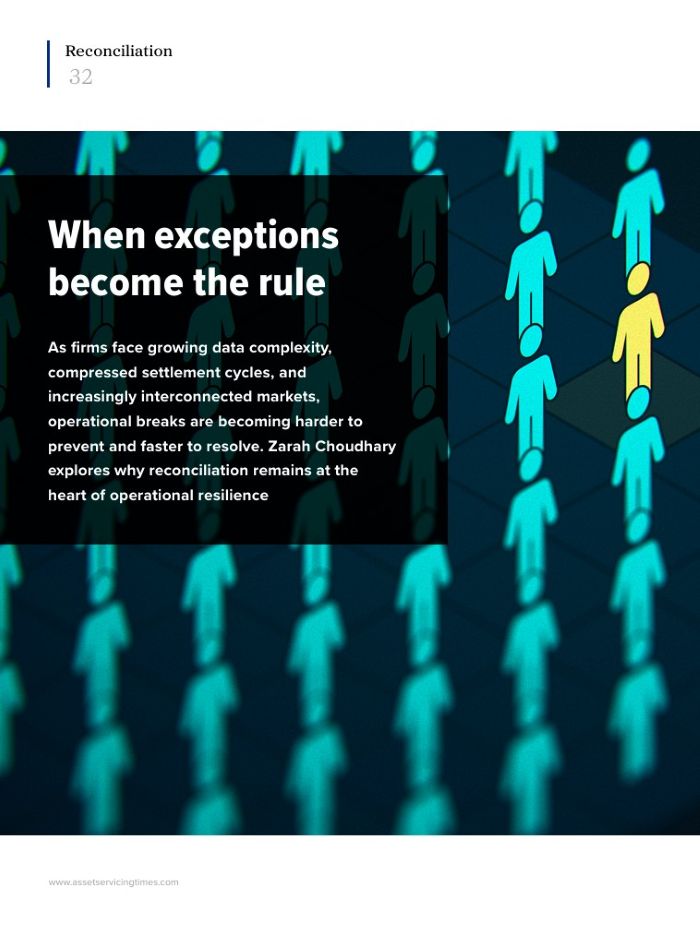
Transaction volumes are growing at more than 25 per cent year-on-year across financial markets, while settlement timelines are shrinking and regulatory expectations continue to intensify. Robin Hasson, Head of Reconciliation Solutions at Smartstream, notes that firms are now running more reconciliations across increasingly complex data – often on infrastructure that was never designed for this level of scale or speed. The European move to T+1 settlement, upcoming SWIFT standards changes, and the growing adoption of tokenised assets are examples of operational change occurring concurrently rather than sequentially.
Data quality sits at the centre of the problem. According to Hasson, up to 67 per cent of asset servicing errors are directly attributable to data quality issues – not matching logic failures, but problems originating upstream. Inconsistent counterparty formats, stale standing settlement instructions, and instrument identifier mismatches are among the most common causes of exceptions, compounded by a lack of front-to-back consistency across many firms’ operating models.
Automation has improved throughput – but not eliminated complexity
Automation has meaningfully improved straight-through processing rates across the industry. Without it, the volume growth of the past decade would have required unsustainable increases in headcount. Yet many firms have automated individual processes without achieving the end-to-end consistency needed to eliminate breaks entirely – leaving operations teams responsible for managing increasingly complex residual exceptions. The challenge is that complexity and automation have evolved in parallel rather than one replacing the other.
Smartstream’s Smart Reconciliations platform is designed to address precisely this gap – providing an enterprise-wide reconciliation layer that unifies exception management, matching, and workflow controls across asset classes and counterparties, rather than treating each process in isolation.
AI moves from theory to production in exception management
AI is increasingly being applied to reconciliation and exception management workflows across the industry – not to replace matching engines, but to enhance investigation, classification, and resolution. Smartstream is seeing particular momentum in exception-heavy environments, where autonomous agents can investigate discrepancies, gather supporting data, and route cases for resolution without manual intervention. Hasson points to measurable outcomes already being achieved: up to a 29x reduction in time per break, 30 to 60 per cent faster resolution times, and up to 70 per cent reduction in manual investigation workload – without adding headcount.
Beyond exception resolution, AI is also being applied to reconciliation configuration and optimisation – automating data mapping, matching rule creation, and ongoing tuning of reconciliation processes. Smart Agents, Smartstream’s agentic AI solution, brings this capability to bear on back-office operations, enabling autonomous planning, multi-step workflow execution, and continuous learning across the exception lifecycle.
T+1 settlement raises the stakes for operational resilience
Shorter settlement cycles are exposing a dependency that many firms have been able to work around under T+2: a deep reliance on end-of-day batch reconciliation. Hasson argues that the shift to T+1 – and the prospect of T+0 beyond that – will require firms to move toward more parallel and near real-time processing models, particularly as Europe prepares for implementation across multiple markets, currencies, and central securities depositories. What was previously manageable within a longer operational window now demands near-real-time visibility and remediation capability.
The firms best positioned for this environment are likely to be those that invest not just in processing speed but in preventing breaks from occurring in the first place – combining stronger data foundations, intelligent automation, and AI-driven exception management to reduce the volume of issues reaching operations teams. Smartstream’s reconciliation portfolio, spanning Smart Reconciliations and the Air AI-enabled data automation platform, is built for precisely this operational model.